

Calcium Carbonate
Calcium Carbonate (CaCO₃) is an inorganic compound derived from natural mineral resources or synthesized through chemical reactions. Characterized by its chemical stability, relatively low hardness, high whiteness, and versatile particle-size and surface properties, Calcium Carbonate is one of the most widely used industrial mineral materials. It serves as a mineral filler, functional filler, and performance-modifying additive across various industries, particularly plastics, rubber, paints and coatings, paper, adhesives, and construction materials.
In industrial applications, Calcium Carbonate serves not only as a partial substitute for base materials to optimize manufacturing costs but also as a functional component that modifies the physical and mechanical properties of finished products. Depending on its particle size, crystal morphology, specific surface area, and surface treatment, CaCO₃ can influence mechanical performance, optical properties, rheological behavior, processability, and structural stability. Its effectiveness is determined by the compatibility between the mineral particles and the host material, as well as the loading level and processing conditions.
Based on manufacturing processes, Calcium Carbonate is primarily classified into two main categories: Ground Calcium Carbonate (GCC), produced through the mechanical grinding of natural minerals, and Precipitated Calcium Carbonate (PCC), synthesized through chemical precipitation. Nano Calcium Carbonate (Nano CaCO₃) represents a specialized segment developed through controlled precipitation technology, featuring primary particle sizes in the nanometer range and distinctive surface properties and material interactions.
Ground Calcium Carbonate (GCC)
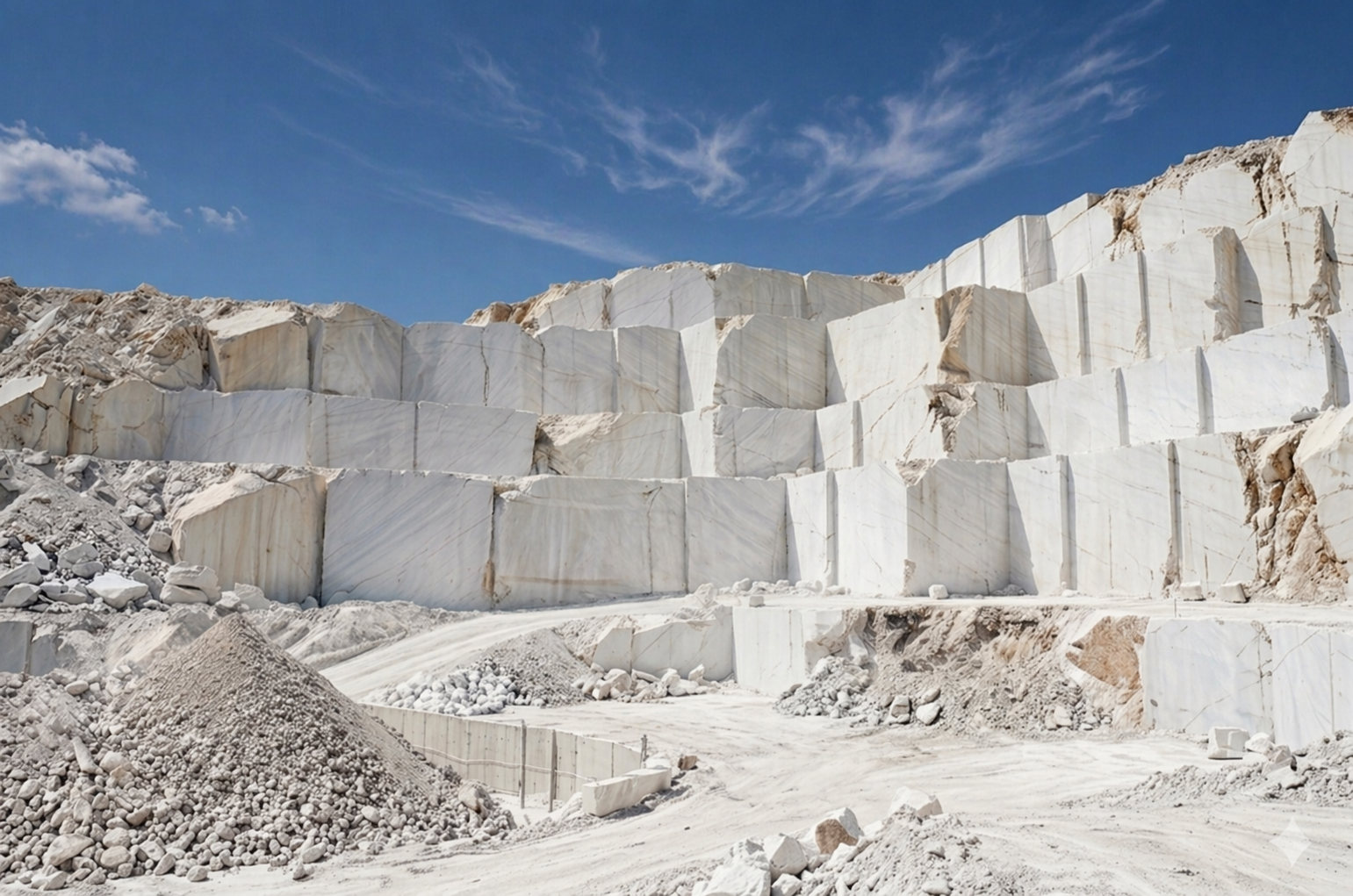
Ground Calcium Carbonate (GCC) is produced through the mechanical grinding of naturally occurring minerals with high CaCO₃ content, primarily limestone, marble, and calcite. The manufacturing process typically involves mineral extraction, raw material selection, coarse grinding, fine grinding, and particle classification using air classifiers or specialized separation systems to achieve the required particle size and distribution. Depending on the processing technology, GCC is available in various fineness grades, ranging from conventional ground powder to ultrafine grades.
The technical properties of GCC are largely determined by the mineral composition and quality of the raw material, particularly CaCO₃ content, whiteness, brightness, and impurity levels, including MgO, Fe₂O₃, and SiO₂. Since GCC is produced through mechanical grinding, its particles generally exhibit irregular shapes, angular surfaces, and particle-size distributions that depend on the grinding and classification technologies employed. Key parameters such as D50, D97, moisture content, and oil absorption are essential indicators for evaluating product quality and suitability for specific industrial formulations.
In addition to Uncoated GCC, surface-treated grades (Coated GCC) have been developed to improve compatibility with organic material systems. The most common treatment method involves stearic acid coating, which reduces the hydrophilic nature of mineral particle surfaces, improves wetting within polymer matrices, and minimizes particle agglomeration during compounding. Surface-treated GCC is particularly important in the production of filler masterbatch, polymer compounds, and plastic products requiring high mineral loading levels.
Precipitated Calcium Carbonate (PCC)
Precipitated Calcium Carbonate (PCC) is manufactured through chemical synthesis, most commonly using the carbonation process. The production process typically begins with the calcination of limestone (CaCO₃) at high temperatures to produce Calcium Oxide (CaO) and carbon dioxide (CO₂). The Calcium Oxide is subsequently hydrated to form Calcium Hydroxide [Ca(OH)₂], which then reacts with CO₂ to produce precipitated Calcium Carbonate. Unlike GCC, which is obtained through the mechanical grinding of natural minerals, PCC is formed through controlled chemical crystallization, allowing manufacturers to regulate particle size, particle-size distribution, crystal morphology, and certain surface characteristics.
One of the key characteristics of PCC is the ability to control crystal structure by adjusting reaction parameters such as temperature, raw material concentration, CO₂ injection rate, pH, reaction time, and crystallization rate. Depending on the synthesis conditions, PCC can develop different crystal morphologies, commonly including rhombohedral, aragonite, and scalenohedral structures. Variations in crystal morphology influence particle size, specific surface area, interaction with host materials, and overall performance in different industrial applications.
Through controlled precipitation technology, PCC can achieve high purity, high whiteness, and consistent product quality. Compared with GCC, PCC offers greater flexibility in controlling crystal morphology and particle structure, providing more opportunities to tailor the functional properties of finished materials. In addition to conventional PCC grades, surface-treated products are also developed to enhance compatibility and dispersion in polymer systems and organic media.
Nano Calcium Carbonate (Nano CaCO₃)
Nano Calcium Carbonate is a specialized grade of Calcium Carbonate characterized by primary particle sizes in the nanometer range, typically between 20 and 100 nm, depending on the manufacturing technology and product specifications.
Most commercial Nano CaCO₃ products are manufactured through controlled precipitation processes and can therefore be considered a specialized segment of PCC, developed to exploit the material properties of Calcium Carbonate at the nanoscale.
At the nanoscale, the surface-area-to-volume ratio increases significantly, resulting in greater contact area between the mineral phase and the host material. This characteristic enhances interfacial interactions, facilitates stress transfer, and enables modifications to the microstructure of composite materials. When uniformly dispersed in a suitable matrix, Nano CaCO₃ can improve certain mechanical properties, including impact strength, tensile strength, tear strength, and deformation resistance.
Surface modification technology plays a particularly important role in commercial Nano CaCO₃ products. Stearic acid coating and other specialized surface-treatment agents modify the surface characteristics of mineral particles, reduce their hydrophilic nature, and improve compatibility with hydrophobic polymer systems. These treatments help minimize particle agglomeration, enhance wetting and dispersion within the host matrix, and improve interactions between the mineral and polymer phases. Depending on application requirements, Nano CaCO₃ is available in both uncoated and surface-treated grades, with strict control over particle size, moisture content, specific surface area, and surface-treatment characteristics.
Industrial Applications

Construction
The construction industry is a key segment in infrastructure development across every nation, covering diverse applications such as flooring systems,...
Learn more
Pulp & Paper
Opportunities for growth. Our products and services include cost-effective to high-performance products for filling and coating and functional coatings, alongside...
Learn more
Polymer
The polymer industry is a cornerstone of modern manufacturing, covering a wide range of applications from plastics to rubber. It...
Learn more
Agriculture
TLD Vietnam is committed to advancing responsible agriculture practices. Our portfolio of solutions addresses the evolving needs of modern agriculture,...
Learn more
Water Treatment
Water treatment is the process that removes the majority of the contaminants from wastewater or sewage and produces a liquid...
Learn more
Personal care & Home care
The Personal care & Home care industry is a fast-growing and dynamic sector, with increasing demand for safe, high-performance, and...
Learn moreWhy choose us!
TLD Vietnam has abundant limestone resources with exceptional purity, whiteness, and brightness, sourced from premium quarries. Combined with advanced production technologies from Germany, Taiwan, and China, we maintain stringent quality control at every stage of the manufacturing process to ensure consistent product quality and compliance with international standards, including ISO, REACH, and RoHS.
Our product portfolio includes Ground Calcium Carbonate (GCC), Precipitated Calcium Carbonate (PCC), and Nano Calcium Carbonate that meet different technical specifications and customer requirements.
With extensive industry experience and in-depth market knowledge, TLD Vietnam is committed to understanding customer requirements and providing reliable calcium carbonate products with consistent quality and professional technical support.
7
FACTORIES
Covering a total area of 60,950 m², with a monthly production capacity of 40,000 MT
70
+
COUNTRIES
Serving customers across 5 continents.
1000
+
CLIENTS
Trusted by clients worldwide for our reliability and strong industry reputation.